
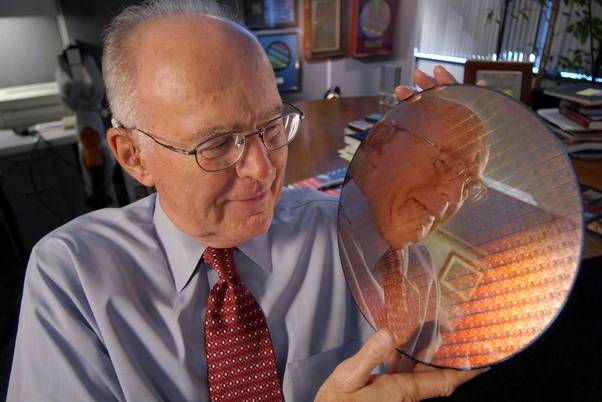
When Gordon Moore first envisioned the doubling of transistor density every two years, he could not predict every mechanism by which that growth would happen. His observation captured the industry’s drive, not its method. Over the years, that drive has persisted, even as the tools have changed. Erik Hosler, a semiconductor industry strategist focused on technology convergence and materials innovation, understands that preserving this momentum now requires expanding beyond traditional paths.
The search for continued advancement has moved well beyond simple miniaturization. Transistors that count alone no longer define progress. Instead, the semiconductor industry is now pushing into a new phase, one defined by novel materials, system-level thinking, and strategic collaboration across domains. At the heart of this shift is the understanding that Moore’s Law still matters, but it must adapt to modern complexity.
A Milestone That Became a Mandate
Moore’s Law started as a prediction, but it quickly became a roadmap. Foundries, designers, and equipment manufacturers aligned their efforts around the expectation that chips would continually become denser and more powerful. This alignment enabled a wave of innovations that gave rise to personal computing, mobile devices, cloud infrastructure, and AI.
But around the 28nm node, the industry began to see diminishing returns. Each subsequent shrink introduced more cost, more variability, and more design complexity. Power efficiency stopped improving at the same rate. Lithographic scaling alone was no longer enough.
Materials as a New Axis of Innovation
If transistor geometry is reaching physical limits, material science offers a new way forward. Emerging materials can reduce resistance, improve mobility, enhance thermal performance, or enable entirely new forms of computing. Examples include:
- High-k metal gates to manage leakage at small scales.
- 2D materials like graphene and molybdenum disulfide for ultra-thin channels.
- Ferroelectrics and phase-change materials for non-volatile memory and neuromorphic computing.
- Photonic-compatible substrates to support optical interconnects.
These materials are not just tweaks. They represent qualitative shifts. They change how chips function, how heat moves, how power is delivered, and how data is stored and transmitted.
Integration Requires Cross-Sector Expertise
New materials rarely operate in isolation. Their adoption requires changes across the stack. Fabrication processes, device architectures, packaging, and software must all be adapted.
That interdependence means innovation now stretches beyond the cleanroom. It includes partnerships between material suppliers, foundries, academic researchers, equipment makers, and software developers. Scaling material from lab concepts to high-volume production takes a network of expertise.
Erik Hosler shares, “It’s going to involve innovation across multiple different sectors.” To extend performance curves, industries must blend insights and resources in ways that have no historical precedent.
Rethinking Device Functionality
Beyond enabling scaling, new materials are allowing devices to behave in new ways. Non-silicon substrates like silicon carbide and gallium nitride enable high-voltage, high-frequency operation for electric vehicles and RF systems. Phase-change materials mimic the function of biological synapses, opening doors to brain-inspired computing.
These shifts matter because they redefine the boundaries of what chips can do. Instead of focusing solely on computational throughput, designers can now optimize durability, sensing ability, energy harvesting, or environmental awareness.
This variety reflects a deeper truth that Moore’s Law has outgrown its original story. It now describes not a fixed path, but a dynamic pursuit of performance.
The Role of Packaging and Heterogeneous Integration
As materials become more diverse, combining them becomes more challenging. Heterogeneous integration, packing multiple chiplets or functions into a single package, allows designers to use the right material for each task.
A logic chip in silicon might be paired with a memory die in phase-change material, a photonic interconnect, and a MEMS sensor. Advanced packaging makes this possible, turning the packaging itself into a platform for innovation. This approach offers a key advantage. It decouples system design from the limitations of any one process. Materials that might not be compatible at the wafer level can coexist at the package level.
From Moore’s Law to More Capable Systems
The result of this development is a shift in focus from transistor density to system capability. What matters most now is what the full device can do, how efficiently it processes data, how fast it communicates, how much power it consumes, and how reliably it operates in the real world.
Materials play a role in each of those goals. They allow chips to perform better, survive harsher conditions, and operate in smaller spaces. They also opened new product categories that were once impossible. By updating Moore’s Law to include material science, the industry honors its spirit and the drive to do more, more effectively.
Education and Workforce Implications
This broadened view of Moore’s Law brings new education and training requirements. Engineers now need to understand not only device physics and circuit design but also chemistry, materials behavior, and manufacturing integration.
University programs are beginning to respond by offering more interdisciplinary training. Industry-academia partnerships are helping to define the next generation of curricula. Workforce development must now prepare people to think across boundaries.
The complexity of the semiconductor future demands a workforce that can operate at the intersections of disciplines, tools, and objectives.
Metrics Must Reflect the Material Impact
Traditional scaling metrics, such as transistors per square millimeter and power per clock cycle, are still useful, but they do not tell the full story. The value of new materials often appears in secondary characteristics, such as signal integrity, thermal reliability, process window margin, and long-term durability.
Industry must adopt richer metrics to evaluate material impact properly. Benchmarking must develop from simple performance curves to full-stack assessments. That change will also help guide investment, research funding, and product roadmaps.
Better measurement enables better decisions. It ensures that the promises of new materials translate into meaningful gains.
A Broader Vision for a Proven Principle
Moore’s Law remains one of the most powerful ideas in technology. It captured the imagination of engineers and investors alike. But to remain useful, it must keep up with the times. Today’s progress is not built only on smaller transistors. It is built on smarter integration, deeper collaboration, and materials that rewrite the rules of performance.
By embracing innovation across multiple sectors, the semiconductor industry is not abandoning Moore’s Law. It is updating it. The future it describes is no longer defined by density but by diversity, ingenuity, and the intelligent application of science. Moore’s Law is alive in every new idea that pushes boundaries. As new materials continue to expand what chips can do, that law remains not just relevant but essential.